|
|


Let all the number of the stars give light
To thy fair way!
(Antony and Cleopatra, Act III:Sec 2, line 1675,
William Shakespeare)
The Problems of Light Pollution -- Overview
Light pollution: Any adverse effect of artificial light including sky glow, glare, light trespass, light clutter, decreased visibility at night, and energy waste. Light pollution is not only a hinderance to astronomy, but it also impacts us directly.
Light pollution:
- is a risk factor for cancer to people
- is a disturbance to animals
- is a waste of energy, resources, and money
- is a security risk to your property
- and obscures our view of the wondrous night sky.
 Use the
links above to learn more information about the different effects that light pollution causes. Light pollution is similar to the
widespread long term damage a toxic chemical spill creates across the land. We ignore this at our own peril and we need to think
about what this means for us.
Use the
links above to learn more information about the different effects that light pollution causes. Light pollution is similar to the
widespread long term damage a toxic chemical spill creates across the land. We ignore this at our own peril and we need to think
about what this means for us.
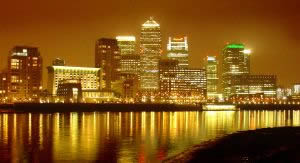
Look at the picture at the right. Do you find yourself asking:
Could you tell by the sky color? Is it night or day there? Would kindergardeners there use a lot of orange for their drawings of the night? While it does look more like a futuristic city on Saturn's moon Titan, excessive and poorly pointed city lights creates a perversely unnatural orange night sky, such as in London, England seen here.
So, with my apologies to Dylan Thomas:
Rage, rage for the majestic wonder of the night.
Identifying Good Light Sources
Before we go into what light pollution is, let us first consider and define why we even use lighting, what good lighting is and what it should do. I know that this may seem terribly basic, but unless we take a small moment to consider these concepts, then we may disagree or misunderstand what is needed to be done.
Why do we even use lighting? - We are a diurnal species. This means that our eyes evolved to function best in the daytime lighting conditions. While we can function at night with a little bit of light with the rod cells in our eyes, say from the Moon, we do not function as well as other species that are truly nocturnal. So, outdoor lighting provides visibility for us to conduct day-like activities at nighttime. Correctly done, we then see good outdoor lighting as an attractive benefit for our communities. Because of our preferences for daytime light levels, and the very basic, primitive fear we feel for darkened places that could hide a predator (those that did not heed such feelings so long ago were, over time, eliminated from passing on offspring!), we very much like light. It gives us a feeling of safety and security, even if the feeling is sometimes inappropriate for a particular situation.
Light can be used to enhance a theme or goals of the community when highlighting somoething it is proud to display. But that one aspect is so increasingly abused by so many that the displayed item just becomes hidden in the ever greater visual noise and clutter. As such, bad lighting is so pervasive and common now, that it is hard for people to recognize that it is so. Yet, there still should be some basic ideas or concepts that everyone would probably agree on that we should expect about what good outdoor lighting to provide.
Good Outdoor Lighting Should:
- Optimize visibility at night for what we want lit
- Minimize energy consumption
- Minimize impact on the environment and ourselves
- Minimize glare
- Minimize light trespass
The second and the third concepts everyone would naturally agree upon, no one wants our resources or money to be intentionally wasted, nor does anyone want our lights to directly cause harm to the environment that we all depend on or to ourselves. The last two concepts are covered down below.
See what's lit, not the light - Believe it or not, it is that first concept, to Optimize visibility
at night for what we want lit
that is often one of the hardest for people to realize, recognize or understand. And yet it sounds
so simple. It simply means this, we want to be able to see those things that are needed to be seen. Being blinded by the source
of the light that provides the illumination is counterproductive to this end. Because the contrasting intensity of a light's
source is often so extreme compared to anything else that is to be lit up by that light, having to see the light's source can actually
impede our ability to see those things that we want or need to see. The Light
pollution vs. Economics page shows an example on this concept.
It is an incredibly simple concept. However, more often than not, what can only be seen is the lights' source
and not the area around it that needs to be illuminated. Sunspots on the Sun have a similar problem. While they look dark to us,
sunspots themselves DO shine out light. However, they are so overpowered by their surrounding, brighter photosphere surface
regions that they look dark. Likewise, decorative lighting in some kind of glassy-brassy housing fixture (or luminaire
)
often makes no effort at all at hiding the source of the light and, as such, it fails in all of the above concepts. Yet how often
does one see decorative lighting used in the front of homes or businesses? It is as if the sole point of the light is to just
see the light itself and not particularly care that anything around it is properly illuminated.
In general, the guiding principle to good lighting can be summed up in this concept:
no light should ever be emitted above
the light source's horizontal plane.
Once this simple guideline is followed, a great deal of the problems regarding light pollution are immediately dealt with and solved.
However, if that principle is not followed, then we encounter a variety of problems from light pollution. The immediate problems that poor lighting can cause are shown below. Other more long term and damaging problems are listed on the other pages linked in the menu above.
Identifying Light Pollution
Light pollution is light that is not being efficently or completely utilized and is often pointed outwards or upwards and not downwards. Hence it is light that is often found to be rude or oppressive to the non-owners of the light. How so? Well imagine spending an hour outside at night to enjoy the stars, when someone walks up to you and shines a flashlight in your face. The light hurts your eyes and temporarily blinds you. Such an action is clearly rude. Yet no one thinks that it is equally and permanently rude that a person installs an outward pointing light on the side of a building to illuminate their grounds or parking lot or area around the building. Such people fail to consider just how far their security lights extend and bother other people. Such owners seem to think that if you wanted it to be dark, then you should go somewhere else. Yet the problem is that in today's society there is no where else to go to avoid lights at night. The darkest region in America, the American desert, can still see the lights of Las Vegas from 250 miles away. Such owners have, in all probability, chosen to locate themself to be close to where people live and work. I can guarantee that the other people, downlight from them, did not move to be near that offender's light.
So let us cover some basic definitions about light pollution:
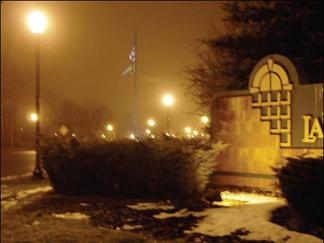
| Urban sky glow - the brightening of the night sky over inhabited areas. It is the "glow" effect that can be seen over distant populated areas. This light that escapes up into the sky is created by the combination of all light reflected off of what is being illuminated, from all of the badly directed light in that area, and from that light that is scattered (redirected) by the atmosphere itself from reaching the ground. This scattering is very strongly related to the wavelength of the light when the air is very clear (with very little aerosols). Rayleigh scattering dominates in such clear air, making the sky appear blue in the daytime. And into the night, the sky no longer appears black. Even if it is not the copper orange color seen to the right, white lights change the color of the night sky from black to a "dark navy blue" and worse. |
|
|
| Image Credit: Chuck Bueter www.nightwise.org |
Light trespass - light falling where it is not intended, wanted,
needed, or where it is NOT appreciated. Street lighting, for example, should illuminate the surfaces of streets and sidewalks, not shine
into peoples' bedroom windows or illuminate rooftops or tree branches. Also called "spill light" (as if you expect them to then say "oh
sorry, my bad" and then "clean it up"), light trespass occurs whenever light shines beyond the intended target and onto adjacent properties.
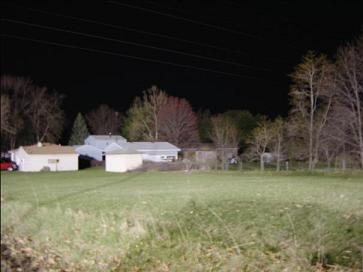
To the left is an image of houses in Grainger Indiana that are irradiated by the newly installed lights of the nearby baseball
fields of the Harris Township Junior Baseball and Softball Association. Officials had said that the new configuration would spill light
that is equivalent to a full moon, yet it is many times stronger. Does anyone really believe that the owners of the houses shown are happy
with the new lights and the interruptions of their sleep?
| Glare - the sensation produced by luminance within the
visual field that is sufficiently greater than that to which the eyes are adapted to. It creates an unnerving, oppressive, annoying,
discomforting feeling that can cause a loss in our visual performance, visibility and can be dangerous. It is the kind of horribly
bright light in your eyes that is often used in intense interrogation scenes you may see in movies. High levels of glare can decrease
visibility for the elderly, drivers of motor vehicles and astronomers. It is easily recognized by when a viewer's pupils will close
down in its presence. This makes dimmer objects harder to see, as less of their light enters the stopped down eyes, and that may
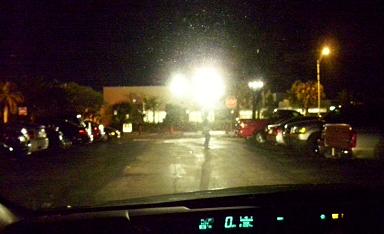
increase the danger. Here a student crosses a crowded parking lot while the driver has to contend with the light at the end of the parking lot. Add a drizzle of rain, and someone's need to hurry and we have the makings of a tragic accident. |
|
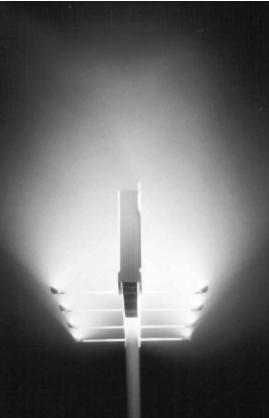
Uplight - wasted
light and energy, pure and simple. Light that goes directly up into the night sky is "lost in space"
and serves no useful purpose (though the most often used for some self centered or vain purposes). Uplight is the bane of astronomers
and the occasional stargazer because atmospheric scattering artificially brightens the night sky, making distant celestial light sources
difficult or impossible to see. Uplight often results from light fixtures which also produce glare and light trespass. And when we
consider the need to be ever more energy conscious, especially as so much of the energy that is consumed to make the polluting light
actually comes from the burning of fossil fuels, that dump ever more CO2 into our atmosphere raising global temperatures,
increasing the changing of the climate, and killing much of the life that can't adapt to the changes (such as coral reefs). It is the
triple wastefulness of it that should so bother everyone, the mass generation of envirnomental damaging carbon dioxide into everyone's
atmosphere, to create distrubing light pollution that has additional damaging effects on us and life at night, for the "purpose to sell
something" on the board, which has no real proof that any of the "selling" plea even works at all.
See also
Adam Kuban's example on the Economics page of wasted uplight.
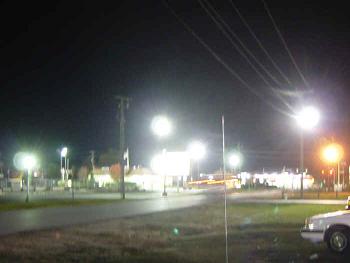
| Clutter - bright, confusing, ugly and excessive groupings of light sources, commonly found
in over-lit urban areas. The proliferation of clutter contributes to urban sky glow, trespass, and glare. Businesses that compete against one another often try to outshine each other. This leads to a one-up-man-ship war that simply hurts everyone else. Note how the clutter basically de-emphansizes each other's store and turns the view into an offensive, ugly, and blinding mess that makes you not want to look at it at all. |
|
The following pages will present some arguments against light pollution. Please spend a moment going through them and learn how light pollution negatively affects you, in so many ways. As there is no staff, except for myself, these pages are being filled in slowly. I'll update the pages over time when I get new information, read more papers, or take more pictures. Please be patient with me and please be pro-active yourself.
If future generations are to remember us with gratitude rather than comtempt,
we must leave them more than the miracles of technology.
We must leave them a glimpse of the world as it was in the beginning,
not just after we got through with it.
-- Lyndon B. Johnson
Florida Atlantic University
Boca Raton, Florida
E-mail: evandern at fau dot edu
Phone: 561 297 STAR (7827)